


A good steam mop feels a bit like cheating. No bucket, no wringing, no harsh cleaner: just hot water vapor and a microfiber pad. Yet the internet is full of confusing claims, and it's easy to buy a mop that doesn't suit your floors, or worse, one that damages them.
This guide covers six popular steam cleaners and mops, what each does well, where each falls short, and how to choose one that fits your home. There's also a section on which floors steam is safe for, since that is the question that matters most and the one that most product pages skip.
A quick note on affiliate links
This article contains affiliate links. As an Amazon Associate, I earn from qualifying purchases. If you buy through one of these links, I may earn a small commission, and it never costs you a penny more. That income helps keep this site running and lets me keep writing detailed, honest reviews of home, kitchen and garden products.
Quick picks
| Pick | Best for |
|---|---|
| Bissell PowerFresh Deluxe | Everyday sealed hard floors |
| Shark Genius S5003D | Touch-free, washable pads |
| LIGHT 'N' EASY | Detachable handheld for grout and glass |
| McCulloch MC1385 | Big deep-cleaning jobs and accessories |
| PurSteam ThermaPro Elite | One machine with many attachments |
| SKG 1500W | Corners and long reach |
How these picks were chosen
I looked at what matters in day-to-day use: how quickly it heats, how easy it is to fill and push, how the pads are handled and cleaned, what floors it is meant for, and how much you get for the money. Specs below come from the product listings and the makers, so treat quoted times and germ-removal claims as manufacturer figures. Prices change often, so check the current listing before buying. I have not run hands-on tests of these products.
The 6 steam cleaners, reviewed

Bissell PowerFresh Deluxe Steam Mop
- Type: Upright steam mop
- Heat-up: About 30 sec (listed)
- Extras: Flip-down scrubber, SpotBoost brush
- Pads: Microfiber
This is the sort of steam mop most households actually need: a stand-up model that heats quickly, has a flip-down scrubber for stuck-on spots and works on sealed hard floors like tile, sealed hardwood and linoleum. The maker says it removes 99.9 percent of bacteria on sealed hard floors, which is a lab result under set conditions, so treat it as a good sign rather than a guarantee of a sterile floor. It also has a scent option, which some people like and others switch off. Fill it with the measuring cup, wait for the light, and go.
What's good
- Quick heat-up and easy to use
- Flip-down scrubber for dried spills
- Suits most sealed hard floors
What to watch for
- Not for carpet or unsealed floors
- Pads need washing and replacing over time
- High-gloss floors can show streaks if you go slowly

Shark Genius Hard Floor Cleaning System Pocket Mop S5003D
- Type: Upright steam mop
- Steam levels: 3
- Pads: Double-sided, washable
- Special: Touch-free pad release
The clever part is the pads. They're double-sided, washable and reusable, and a button lets you drop a dirty one without touching it. Three steam settings let you go gentle on delicate floors and stronger on kitchen tile. It's a sensible pick if you hate handling grimy pads or want to cut down on disposable cleaning cloths. Before you buy, look at the listing for how the water tank fills and whether it comes out, since that affects how easy it is to top up mid-clean.
What's good
- Touch-free pad release
- Washable, reusable double-sided pads
- Three steam settings
What to watch for
- Check the tank design before buying
- Pads need laundering after use
- Not for unsealed or delicate floors
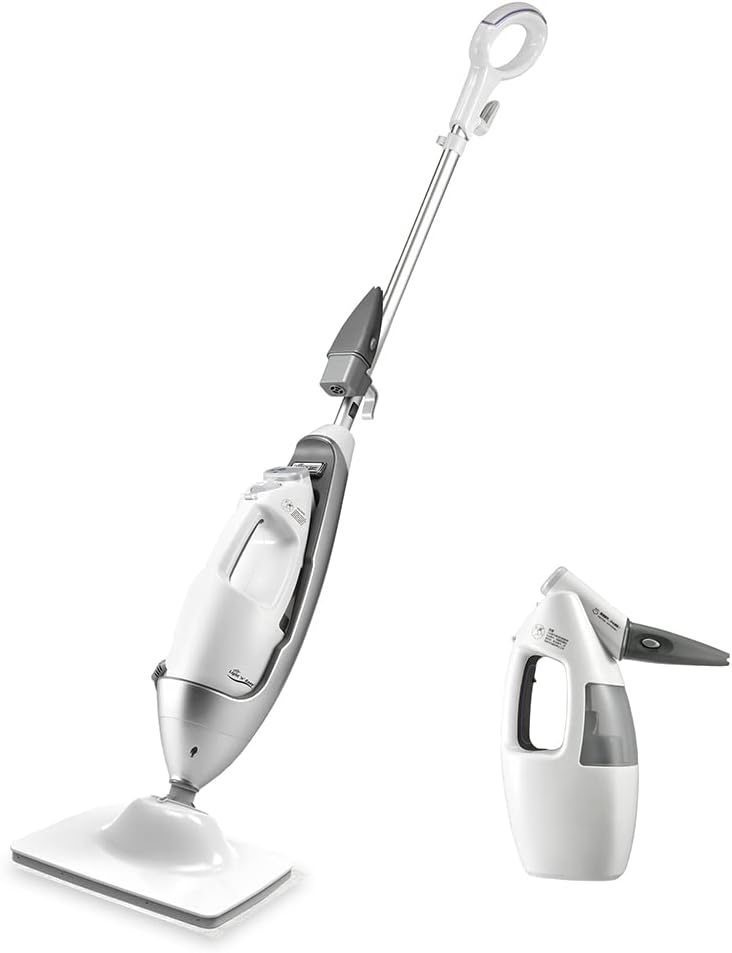
LIGHT 'N' EASY Multi-Functional Steam Mop
- Type: Mop with detachable handheld
- Attachments: Nozzle, brush, squeegee, garment pad
- Head: Swivels
- Heat-up: About 30 sec (listed)
The handheld steamer that detaches from the mop is the main draw. It turns one appliance into two: a mop for floors and a small steamer for grout, sinks, tiles, glass and fabrics. The listing describes a swiveling head and a safety feature that releases steam only when the mop moves. Small tanks are the usual trade-off with this style, so expect a refill on bigger jobs, and be careful using steam on fabrics and upholstery, since the maker's instructions vary.
What's good
- Two tools in one with the detachable handheld
- Swiveling head goes around furniture
- Attachments for grout, glass and more
What to watch for
- Small tanks may need mid-job refills
- Handheld can feel heavy over long sessions
- Read the manual before steaming fabrics

McCulloch MC1385 Deluxe Canister Steam Cleaner
- Type: Canister steam cleaner
- Tank: 64 oz, up to 120 min
- Power: 1,500 W, 4 bar / 58 psi
- Extras: 23 accessories, 18 ft cord
This isn't a mop in the usual sense. It's a canister steam cleaner with a hose, wands and a mop head, and it's built for bigger jobs: grout, tile, appliances, glass, outdoor furniture and floors. The 64 ounce tank runs for up to two hours per the manufacturer, and the steam level is adjustable. The trade-offs are size and weight (about 13 pounds) and a heat-up time of roughly 12 minutes. The maker recommends it for tile, sealed hardwood, laminate and concrete.
What's good
- Large tank and long steam time
- 23 accessories for many surfaces
- Adjustable steam and lockable trigger
What to watch for
- Heavier and bulkier than a stick-style mop
- Around 12 minutes to heat up
- More than most people need for floors alone

PurSteam ThermaPro Elite 12-in-1 Steam Mop
- Type: Multi-function steam mop
- Uses: Floors, carpet glider, glass, garments
- Steam: Adjustable
- Head: Swivel steering
The 12-in-1 name means a big set of attachments: floor pads, a carpet glider, a window tool and a garment steamer. Adjustable steam and a swiveling head keep it manageable. It's a fair choice if you want one machine to handle several jobs, though a multi-tool bundle rarely does every job as well as a dedicated tool. The carpet glider, for example, refreshes carpet rather than deep-cleaning it.
What's good
- Lots of attachments in one box
- Adjustable steam levels
- Swivel head for tight spaces
What to watch for
- Tank size may be limiting on large homes
- Carpet glider is for freshening, not deep cleaning
- Can be harder to push on some surfaces

SKG 1500W Non-Chemical 212F Hot Steam Mop
- Type: Upright steam mop
- Power: 1,500 W
- Head: Triangular
- Cord: 16.4 ft
A triangular head that gets into corners and a 16.4 foot cord that reaches most of a room without a plug swap are the highlights here. It comes with a handful of accessories and is aimed at laminate, tile and other sealed floors. As with any steam mop, go easy on laminate and check the flooring maker's advice first, and keep the mop moving so steam and moisture don't sit in one spot.
What's good
- Triangular head reaches corners
- Long cord means fewer plug changes
- Handful of useful accessories
What to watch for
- Fewer attachments than the bundle models
- Some users find the handle tiring
- Can leave more moisture if you move slowly
How a steam mop actually works
Inside the machine, a small boiler or heating element turns water into steam. That steam travels to the mop head and passes through a microfiber pad, where the heat and moisture loosen sticky dirt and grease so the pad can lift it away. There's no cleaning solution involved, which is the main appeal. If you have kids, pets or sensitive noses, skipping bottles of floor cleaner is a real plus.
Steam doesn't remove loose dirt, though. Crumbs, hair and grit need to be swept or vacuumed first. Otherwise the pad just pushes debris around and picks up a gritty film. Think of steam as the second step, not the first.
Which floors are safe, and which aren't
This is the most important thing to know before you buy. Steam is hot and wet, and some floors can't take it.
Usually fine (if sealed)
- Ceramic and porcelain tile, including the grout lines if the grout is sealed.
- Sealed hardwood, when the flooring maker allows steam cleaning. Some don't.
- Sealed stone, such as granite or sealed marble, when the manufacturer says it's okay.
- Linoleum and many types of vinyl, as long as seams are tight.
- Concrete, when sealed.
Use caution or avoid
- Unsealed or waxed hardwood. Moisture can seep in and damage the finish and boards.
- Laminate. Many manufacturers warn against steam because water can get into the seams and cause swelling. Check yours before you try it.
- Luxury vinyl planks with loose or lifting seams. Heat and moisture can affect the adhesive.
- Unsealed stone, grout or porous tile. Steam may darken or damage them.
- Carpet and rugs, unless the model has a specific carpet attachment and you use it as directed.
When in doubt, check the flooring manufacturer's care guide, and test the mop on a small hidden area first. It's also wise to keep the mop moving. Leaving a hot, damp pad in one place is the fastest way to damage a floor.
What about the "kills 99.9% of germs" claim?
You'll see this on nearly every steam mop box. It's worth understanding what it means. Manufacturers usually test their products on hard, non-porous surfaces under set conditions, including how long the steam stays in contact with the surface. Real homes are messier. If you move quickly over a floor, the steam may not stay in contact long enough to match lab conditions, and porous surfaces are harder to clean.
Steam does clean and freshen hard floors very well, and it's a good chemical-free option. But treat the germ claim as a sign the mop gets hot, not as a promise of a sterile floor. If you have a specific hygiene concern, follow official guidance for disinfecting rather than relying on a steam mop alone.
Types of steam cleaner
Stick or upright steam mops
These look like a vacuum handle with a cleaning head. They're light, quick to start and best for regular floor cleaning. The Bissell, Shark, PurSteam and SKG models above are of this type. They're the easiest to store and use.
Steam mops with a detachable handheld
These pop off a small steamer for grout, sinks, tiles and glass. The LIGHT 'N' EASY is an example. They give you flexibility, though the handheld part is often small and may not have the power of a full canister.
Canister steam cleaners
These have a boiler you set on the floor and a long hose with attachments. The McCulloch is one. They hold more water, produce steam for longer and can tackle grout, ovens, upholstery and outdoor furniture. They're heavier and take longer to heat up.
What to look for when buying
Your floor type. Decide first what you'll clean. If your floors are laminate or unsealed hardwood, a steam mop may not be the right tool at all.
Heat-up time. Stick models usually heat in under a minute, while canisters can take ten minutes or more. If you clean in short bursts, quick heat-up matters.
Tank size and how it fills. A bigger tank cleans longer without refills but adds weight. Check whether the tank is removable, since a removable one is easier to fill at the sink.
Weight and maneuverability. A swiveling head helps around furniture and in corners. If you have stairs between rooms, lighter is better.
Adjustable steam. Lower settings protect delicate floors, and higher ones tackle stubborn spots.
Pads. Look for washable microfiber pads and check how easy they are to swap. Spare pads are cheap and worth having so you can rotate them.
Cord length. A longer cord means fewer plug changes. Around 15 to 20 feet covers most rooms.
Attachments. More isn't always better. Choose the ones you'll really use, such as a grout brush or a window squeegee.
Warranty and support. A steam mop is a heated appliance with a boiler, so a decent warranty is reassuring.
How to use a steam mop, step by step
- 1. Clear and sweep the floor. Pick up loose items, then sweep or vacuum well.
- 2. Fill the tank. Use the measuring cup if there is one, and follow the manual on water type.
- 3. Attach a clean pad. Make sure it's firmly in place.
- 4. Plug in and wait. Let the indicator light tell you when steam is ready.
- 5. Test a hidden spot. Try the floor in a closet or corner before you do the whole room.
- 6. Mop in slow, steady passes. Work in sections and don't let the mop sit still.
- 7. Change the pad when it's dirty. A grimy pad spreads dirt instead of lifting it.
- 8. Unplug, cool and empty. Let the unit cool, empty any water and wash the pads.
Tips for better results
Work from the far corner toward the door. That way you never walk on a wet floor.
Use a slow pass on sticky spots. Give steam a few seconds to loosen dried spills before you scrub.
Use a scrubbing pad for heavy grime. Some models include one or a flip-down scrubber.
Let floors dry. Steam floors dry fast, but ventilate the room and avoid walking on it right away.
Rotate pads. Keep two or three so a clean one is always ready.
Don't overfill. A full tank isn't better if it makes the mop heavy.
Caring for your steam mop
Empty the tank after each use. Standing water leads to mineral buildup and odors.
Watch out for scale. In hard water areas, mineral deposits can clog the boiler and reduce steam. Many manuals recommend distilled or demineralized water, and some allow tap water. Follow yours, since using the wrong water can void a warranty.
Wash the pads. Machine wash them without fabric softener, which coats the fibers and reduces absorbency. Air dry or tumble on low.
Clean the head. Wipe the base and check the steam holes for lint or debris.
Store it safely. Let it cool completely, keep the cord loosely wrapped and store it upright or hung up.
Safety
Steam can scald, and the mop head and pad get hot. Keep children and pets out of the room while you clean, never point the steam at people or animals, and unplug the mop before refilling. Don't touch the pad right after use. Keep the cord away from the steam path and out of walkways. If you use a canister or handheld, take extra care with the hose and nozzle, which can also be very hot.
Common mistakes
- Using steam on the wrong floor. Check your flooring first.
- Skipping the sweep. Dirt and grit get smeared.
- Standing still. Leaving the mop in one place damages floors.
- Using a dirty pad. It just moves grime around.
- Ignoring the manual on water. Wrong water can cause scale and void warranties.
- Expecting miracles on grout or carpet. Steam helps but isn't magic.
- Leaving water in the tank. It causes buildup and smells.
Frequently asked questions
Can I use a steam mop on hardwood floors?
Only on sealed hardwood, and only if the flooring maker allows steam cleaning. Unsealed or waxed hardwood can be damaged by moisture and heat. Test a hidden spot first.
Is a steam mop safe for laminate?
Many laminate makers advise against it, because moisture can get into the seams. Check the manufacturer's advice for your floor before using steam.
Do steam mops really kill germs?
Steam is hot enough to be effective in lab tests, but real-world results depend on contact time and the surface. It cleans well and is chemical-free, but don't treat it as guaranteed sterilization.
Can I add cleaning solution or fragrance to the water?
Usually no. Most makers say to use plain water, and additives can clog or damage the machine. If a model has a scent feature, use only the approved scent pads or discs.
Should I use distilled water?
It depends on the manual. Distilled water reduces mineral buildup in hard water areas, and some makers recommend it. Others allow tap water. Follow your model's instructions.
How long does a steam mop take to heat up?
Stick models are often ready in about 30 seconds, while canister cleaners can take around 10 to 12 minutes. Check the listing for the specific model.
What's the difference between a steam mop and a steam cleaner?
A steam mop is designed mainly for floors and is light and easy to use. A steam cleaner, especially a canister type, has a hose and attachments for grout, appliances, glass and more, but it's heavier and slower to start.
How often should I replace the pads?
When they look worn, matted or no longer pick up dirt well. With regular washing, many last months, but it varies with use.
The bottom line
For most homes with sealed tile or hardwood, an upright steam mop such as the Bissell or Shark is the simplest choice. If you want a mop that also handles grout, glass and small jobs, the LIGHT 'N' EASY or PurSteam bundles give you more range. For big deep-cleaning tasks, the McCulloch canister is in a different class, as long as you don't mind the weight. And the SKG is worth a look if you value corner reach and a long cord.
Whichever you choose, sweep first, check that your floors can handle steam, keep the mop moving and rotate your pads. Do that and a steam mop will quickly become one of the most satisfying tools in your cleaning kit.


No comments:
Post a Comment