


Small lawns have a funny problem. You'd think less grass means an easier job, but most sprinklers are built for big yards. Turn one on and half the water lands on the driveway, the fence or your neighbor's flowerbed. Meanwhile, a corner of your own grass stays crispy and brown. Choosing the right sprinkler for a small lawn is less about power and more about control: how well can you shrink the pattern to fit your space?
This guide covers six popular sprinklers, what each does well, where each falls short, and how to pick one that suits the shape of your lawn. There's also a short section on how much water grass actually needs and when to give it, because the best sprinkler in the world won't help if the timing is wrong.
A quick note on affiliate links
This article contains affiliate links. As an Amazon Associate, I earn from qualifying purchases. If you buy through one of these links, I may earn a small commission, and it never costs you a penny more. That income helps keep this site running and lets me keep writing detailed, honest reviews of home, kitchen and garden products.
Quick picks
| Pick | Best for |
|---|---|
| Rain Bird 25PJDAC | Durability, fine control of the arc |
| Melnor XT Turbo | Adjustable oscillating pattern |
| Orbit Yard Enforcer | Keeping animals out (not a full sprinkler) |
| Gardena ZoomMaxx | Irregular shapes and narrow strips |
| Dramm ColorStorm | Simple round watering |
| Aqua Joe SJI-OMS16 | Budget-friendly oscillating |
How these picks were chosen
I looked at what matters for a small yard: adjustable coverage so you can keep water off paving, a build that will last past one summer, ease of setup, and how well each design copes with common problems such as clogged nozzles. Coverage figures below come from the product listings and manufacturers, and they are maximums, not what you will get in a small lawn. Prices change often, so check the current listing before buying. I have not run hands-on tests of these products.
The 6 sprinklers, reviewed

Rain Bird 25PJDAC Brass Impact Sprinkler
- Type: Impact
- Pattern: 20 to 360 degrees
- Reach: 20 to 41 ft radius
- Build: Brass, bronze, stainless steel
This is the classic tick-tick-tick sprinkler, and it has earned its reputation. The body is metal, the design goes back decades, and it copes with dirty or mineral-heavy water that clogs finer nozzles. The adjustable arc lets you water just the lawn and skip the driveway, and a diffuser screw breaks the stream into smaller droplets and can shorten the reach by up to 25 percent. Here's the thing for small lawns: its maximum reach is generous, so you'll be dialing it down rather than up. Check the listing for the thread type before you order. The 25PJDAC head is described by Rain Bird as having a half-inch inlet, and some retail listings mention a hose thread, so you may need an adapter or a hose-end version with a spike.
What's good
- Metal construction that lasts for years
- Arc from a narrow wedge to a full circle
- Handles dirty or hard water well
What to watch for
- Reach is bigger than a tiny yard needs, so it takes some tuning
- Check the connection type; you may need an adapter or spike
- The impact sound isn't everyone's favorite
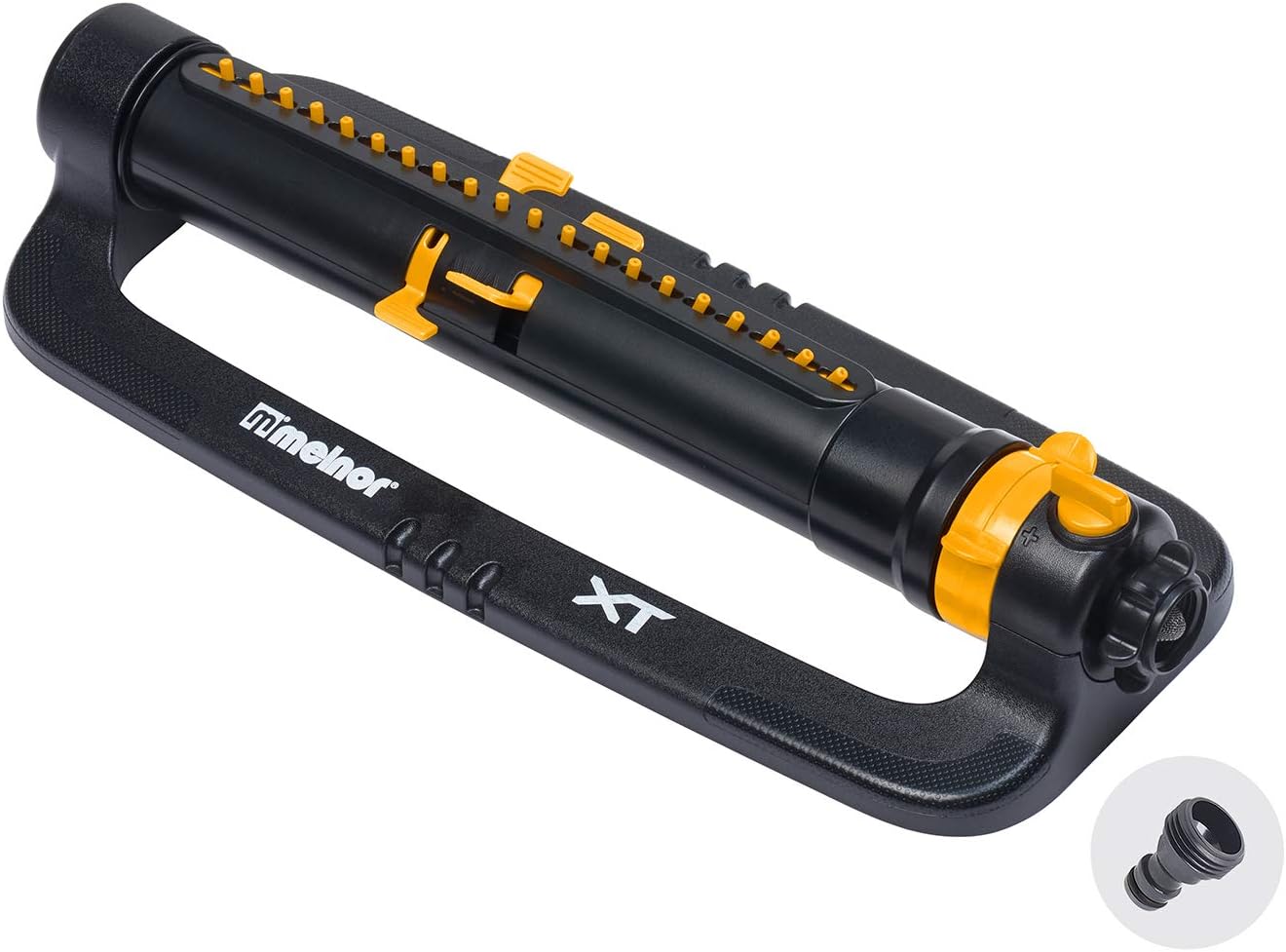
Melnor 65078-AMZ XT Turbo Oscillating Sprinkler
- Type: Oscillating
- Listed coverage: Up to 4,500 sq ft
- Nozzles: 20 rubber nozzles
- Controls: Width and range adjustment
Oscillating sprinklers sweep a rectangle, which suits most yards better than a circle. The Melnor lets you narrow the pattern with simple controls, so you can shrink the watering area to fit a small lawn instead of soaking the sidewalk. The listing quotes coverage up to 4,500 square feet, which is far more than a small lawn needs, so the real value is how far you can shrink it. Rubber nozzles are easy to clear, and a quick poke with a pin usually gets a blocked one flowing again.
What's good
- Adjustable width and range for small spaces
- Rectangular pattern fits most lawns
- Rubber nozzles are simple to clear
What to watch for
- Plastic body isn't as tough as metal models
- Fine spray can drift in wind
- Needs occasional cleaning to stay even

Orbit 62100 Yard Enforcer Motion-Activated Sprinkler
- Type: Motion-activated impact
- Detection: Up to 40 ft, 120 degree view
- Spray: Up to 35 ft
- Power: Battery for the sensor
Be clear about what this is. The Yard Enforcer is mainly a pest deterrent: it senses movement and fires a burst of water at deer, cats, dogs or raccoons, and that noise and spray teaches animals to stay away. It also has a timed watering mode, so it can water for a set period, and its outlet lets you connect additional sprinklers. That makes it a smart companion to a regular sprinkler if animals are wrecking your lawn or garden. It just isn't the right choice as your only lawn sprinkler. Sensitivity may need adjusting so wind-blown plants and small animals don't set it off, and it needs enough water pressure to work well.
What's good
- Keeps deer, cats and dogs off the lawn
- Day, night or 24-hour modes
- Outlet for adding another sprinkler
What to watch for
- Not designed as a full lawn irrigation sprinkler
- Sensor needs tuning to avoid false triggers
- Needs batteries and decent water pressure

Gardena 38124 ZoomMaxx Oscillating Sprinkler on MetalStep Spike
- Type: Oscillating on spike
- Listed coverage: 76 to 2,300 sq ft
- Nozzles: 16 flexible nozzles
- Base: Metal step spike
The selling point is flexibility. Controls let you set the width, the length and the flow separately, so you can water a small square, a long thin strip or something in between. It sits on a spike that you press into the soil, which keeps it steady rather than letting it wander with the hose. If your lawn has awkward corners or narrow beds, this is the type of sprinkler that copes with them. Take a minute to learn the controls, because they do more than the basic dial-and-go designs.
What's good
- Independent width, length and flow control
- Spike keeps it steady
- Covers small squares and long strips
What to watch for
- More settings to learn at first
- Spike is harder to push into dry, hard soil
- Listing quotes are maximums, so measure your yard

Dramm 15075 ColorStorm Spinning Sprinkler
- Type: Spinning, stationary
- Pattern: Round
- Listed reach: Up to about 38 ft across
- Options: Several colors
Nothing to adjust, nothing to fiddle with. You connect the hose, turn on the tap, and the head throws water in a circle. It's good for a round bed, a square patch of lawn near the center, or a spot where you want low-fuss watering without a sweeping arm. The catch is geometry: a circle overlaps the corners of a rectangular lawn poorly, so you may water the edges more than you need or miss the corners. It comes in several colors, which makes it easy to spot in the grass.
What's good
- Very simple, with nothing to set up
- Stable stationary base
- Easy to see in several colors
What to watch for
- Round pattern doesn't fit rectangular lawns well
- Little adjustability
- May waste water on paving at the edges

Aqua Joe SJI-OMS16 Indestructible Metal Base Oscillating Sprinkler
- Type: Oscillating
- Listed coverage: Up to 3,600 sq ft
- Nozzles: 16 clog-resistant nozzles
- Base: Metal base
A no-frills oscillating sprinkler with a metal base that keeps it planted while it sweeps back and forth. Range control tabs let you set how far the spray travels, and a clean-out tool is attached to the unit, so a blocked nozzle is a quick fix rather than a chore. The listing may show the Sun Joe name, which is the same company. As with the other oscillators, the coverage figure is a maximum, so tune the tabs down to keep water on the lawn.
What's good
- Metal base stays put
- Range tabs for narrowing the spray
- Clean-out tool for clogged nozzles
What to watch for
- Tabs can be fiddly to adjust
- Nozzles still clog in hard water
- Brand name on the listing may differ from the box
What counts as a small lawn, and how to measure yours
There isn't an official cutoff, but as a rough guide, a lawn under a couple of thousand square feet feels small to most people. Measuring yours takes two minutes. For a rectangle, multiply length by width. A patch that's 25 feet by 40 feet is 1,000 square feet. For an odd shape, split it into rectangles and triangles, work out each and add them together.
Now compare that figure with the coverage claims. A sprinkler that says it covers 4,500 square feet doesn't mean it will do a great job on 800. It means it can stretch that far when fully open. What you want is a model that closes down neatly to your size, so keep an eye out for range and width controls.
Which type of sprinkler suits which lawn?
Oscillating sprinklers
These swing a curved tube back and forth, throwing water in a rectangle. They suit square or rectangular lawns best and are easy to adjust with sliders or tabs. The Melnor, Gardena and Aqua Joe models above are all oscillators. Their downside is that the fine spray can drift in wind and lose water to evaporation on hot afternoons.
Impact sprinklers
These are the ones that go tick-tick-tick as an arm taps a nozzle. The spray is heavier and travels farther, so it suits wind better. You can set the arc to cover a wedge, a half circle or a full circle. The Rain Bird is a good example, and it's a fine choice if your lawn is irregular or you want to water a specific part.
Spinning and rotary sprinklers
These throw water in a circle, usually from a simple base. They're the easiest to use but the least adjustable. The Dramm ColorStorm fits here. They're best for round patches and small spaces, less so for rectangular lawns, because the corners often go dry while the edges overlap onto paving.
Motion-activated sprinklers
These aren't for routine watering. They sense movement and spray a startling burst of water to scare off animals. The Orbit Yard Enforcer is the well-known one. Think of it as a guard dog, not a gardener.
Which do most people choose?
For a small rectangular lawn, an adjustable oscillating sprinkler is usually the simplest answer. If your lawn is oddly shaped, an impact sprinkler with an adjustable arc gives you more freedom. If you just want to water a single round area, a spinner is enough.
How much water does a lawn need?
Most lawn care guidance from university extension services suggests roughly one inch of water per week, from rain and irrigation combined, and a little more during very hot weather. It's better to water deeply and less often than to sprinkle a little every day, because deep watering encourages roots to grow down instead of staying near the surface.
There's an easy way to find out how long to run your sprinkler. Put a few shallow, flat-bottomed containers, such as empty tuna cans, around the lawn. Turn the sprinkler on and time how long it takes to collect an inch of water. That's your run time for a weekly deep soak. Sprinklers differ a lot in output, so you'll need to do this test for your own model and pressure. Many people find they need somewhere between 30 and 60 minutes per session, but it depends on the sprinkler, your water pressure and your soil.
Signs your lawn needs water include footprints that stay pressed into the grass, a dull blue-gray color, and blades that curl or fold. Signs you're overdoing it include puddles, a spongy feel underfoot and mushrooms.
When to water
Early morning is best, ideally before about 10 a.m. Temperatures are cooler, wind is usually lighter and less water evaporates before it soaks in. Watering in the evening can leave grass damp overnight, which some lawns can't tolerate because it encourages fungal disease. Midday is the least efficient time, since much of the water evaporates.
Also check your local rules. Many towns and water districts restrict outdoor watering on certain days or hours, especially in dry summers, so it's worth a quick look at your utility's website.
Water pressure and hose tips
Sprinklers perform best at the pressure they were designed for. Very low pressure gives a weak, uneven pattern, while very high pressure can turn the spray into mist that blows away. If your sprinkler seems weak, check for kinks, a partly closed tap, a clogged filter screen at the hose connection, or a hose that's too long or narrow.
A few habits help:
- Use a good hose. Wider hoses deliver more water over distance, and kink-resistant ones save frustration.
- Check the washer. A worn rubber washer at the connection leaks. It costs pennies to replace.
- Open the tap fully. Then adjust at the sprinkler rather than the tap.
- Use a timer. An inexpensive hose-end timer turns the water off when the time is up, so you don't forget it running.
How to set up a sprinkler on a small lawn
- 1. Place it in the middle. On a small lawn, centering the sprinkler usually gives the most even coverage.
- 2. Start with a narrow pattern. Set the range and width smaller than you think you need, then widen until the water just reaches the edges.
- 3. Keep spray off paving. Watering the driveway or sidewalk wastes water and can create slippery surfaces.
- 4. Watch the wind. On a breezy day, move the sprinkler closer to the windward side, or wait for calmer weather.
- 5. Run the tuna can test. Measure how much water each part of the lawn actually receives.
- 6. Move it if you need to. If one corner stays dry, rotate the sprinkler or shift it a few feet on the next session.
- 7. Set a timer. A kitchen timer or a hose timer prevents forgotten sprinklers and huge water bills.
Keeping your sprinkler working
Clean the nozzles. Oscillating models have small holes that clog with mineral deposits or debris. A pin or the included clean-out tool clears them. If mineral buildup is heavy, soaking the head in vinegar can help.
Clear the filter. Many sprinklers have a small screen at the inlet. Take it out and rinse it at the start of the season.
Drain and store. Before freezing weather, drain the sprinkler and bring it inside. Water left in a plastic body can freeze and crack it.
Check the washer. A leaky connection reduces pressure to the sprinkler and wastes water.
Lubricate moving parts if the maker says so. Some models have a gear or arm that benefits from occasional care. Follow the manual.
Common mistakes
- Buying for maximum coverage. On a small lawn, a smaller adjustable pattern is more useful than a huge one.
- Watering every day for a few minutes. Deep, less frequent watering builds stronger roots.
- Watering at midday. Much of the water evaporates.
- Ignoring wind. Fine mist drifts, so reposition or wait.
- Leaving the sprinkler running. Use a timer.
- Forgetting to clean nozzles. Clogs create dry stripes.
- Using a motion sprinkler as a lawn sprinkler. It isn't designed to water a lawn evenly.
Frequently asked questions
What is the best sprinkler for a small lawn?
For a small rectangular lawn, an adjustable oscillating sprinkler is usually the most practical. For irregular shapes, an impact sprinkler with a variable arc works well. Choose the one whose pattern you can shrink to fit your yard.
How long should I run a sprinkler on my lawn?
It depends on your sprinkler, pressure and soil. Use the tuna can test to find how long it takes to deliver about an inch of water, and aim for that once a week, adjusting for rain and heat.
Is an oscillating or an impact sprinkler better?
Oscillating models suit rectangular lawns and are easy to adjust. Impact sprinklers handle wind better and are good for odd shapes and precise arcs. Neither is better in every situation.
Can the Orbit Yard Enforcer water my lawn?
It has a timed watering mode and can connect to another sprinkler, but it's mainly designed to scare pests. Use a regular sprinkler as your main lawn watering tool.
What time of day is best for watering a lawn?
Early morning, ideally before 10 a.m. Cooler temperatures and lighter winds mean less evaporation, and the grass dries during the day.
How do I stop my sprinkler from watering the driveway?
Use the range or arc adjustments to narrow the pattern, and place the sprinkler so the spray stops at the edge of the lawn. Impact sprinklers with adjustable arcs are good at this.
Why is my sprinkler weak or uneven?
Check for clogged nozzles, a blocked inlet screen, kinks in the hose, a worn washer or low water pressure. Clean the nozzles first, since it's the most common cause.
How do I winterize a sprinkler?
Disconnect it from the hose, drain all the water, dry it and store it indoors. Water left inside can freeze and crack the body.
The bottom line
The best sprinkler for a small lawn is the one you can tune to your space. If you want a tough, long-lasting sprinkler with precise arc control, the Rain Bird impact head is hard to beat. If you prefer a simple, adjustable oscillating pattern, the Melnor, Gardena and Aqua Joe models are all solid choices. For a round patch, the Dramm is easy and inexpensive. And if wildlife keeps raiding your yard, the Orbit Yard Enforcer is a clever add-on, just not a replacement for your main sprinkler.
Measure your lawn, start with a narrow pattern, water early and deeply, and use a timer. Do those four things and even a modest sprinkler will keep a small lawn looking great.


No comments:
Post a Comment